Most small businesses do not have a Google problem. They have a visibility problem. If your competitors show up in the map pack and you do not, this Google Business Profile optimization guide will help you fix the gaps that keep you from earning calls, clicks, and direction requests.
Your profile is often the first impression a customer gets. Before they visit your website, they see your reviews, hours, services, photos, and business category. In many cases, they make a decision right there. That is why optimizing a profile is not busywork. It is local lead generation.
What Google Business Profile optimization actually means
A lot of business owners think optimization means filling out the basics once and moving on. Name, address, phone number, done. That is not enough anymore.
A well-optimized profile sends strong local relevance signals to Google and gives customers confidence to contact you. That includes accurate business data, the right categories, strong service descriptions, current photos, review activity, and regular updates. It also means avoiding the shortcuts that can trigger suspensions or hurt trust.
The trade-off is simple. A bare profile may still exist, but it usually underperforms. A complete and actively managed profile has a better chance of showing in Google Maps and converting searchers into leads.
Start with the parts that affect trust first
Before you worry about weekly posts or photo strategy, make sure the foundation is right. Local rankings are hard to improve when core business details are inconsistent or incomplete.
Business name, address, and phone number
Use your real-world business name exactly as it appears on signage and legal records. Do not stuff extra keywords into the name field. It may seem like an easy win, but it creates compliance risk and can lead to edits, suspensions, or ranking volatility.
Your address and phone number should match what appears on your website and major directory listings. Even small differences can weaken trust signals. If you are a service-area business, set your service area correctly and hide the address if customers do not visit that location.
Hours, holiday hours, and primary contact details
Hours matter more than many owners realize. Inaccurate hours create bad experiences, negative reviews, and lost trust. Keep regular hours updated and add holiday hours ahead of time. If your business takes calls after hours, make sure the profile reflects how customers should reach you.
This is basic work, but it directly affects whether a prospect contacts you or moves on.
Choose categories like they affect revenue, because they do
Your primary category is one of the strongest signals in your profile. It helps Google understand what you do and which searches you should appear for. Choosing the wrong one can hold back rankings even if everything else looks fine.
Pick the most specific primary category available for your core service. Then add secondary categories that reflect other real services you provide. Do not add categories just because they sound related. Relevance matters more than volume.
A plumber should not choose general contractor unless that is truly the main business. A med spa should not use beauty salon if its most valuable services are aesthetic treatments. Better category choices often lead to better visibility without changing anything else.
Fill out services and business descriptions with intent
Google gives you room to explain what you do. Use it well.
Your business description should clearly state your main services, who you serve, and where you operate. Keep it factual and customer-focused. Skip hype and write the way a real customer thinks. If you are a roofing company serving three counties, say that plainly. If you are a family dentist offering implants and emergency care, say that plainly too.
In this Google Business Profile optimization guide, details matter
Service lists help both users and search engines understand your offer. Add each legitimate service individually when possible. This is especially useful for service-area businesses that want to show relevance across multiple offerings.
Descriptions should support clarity, not cram in keywords. If a service field lets you explain the work, mention what the service is, who it is for, and any high-intent qualifiers that are actually true. Think emergency repair, same-day service, free estimates, or commercial and residential work. Those details can improve conversion because they answer questions before the customer clicks.
Reviews are not just social proof
Reviews influence rankings, click-through rates, and conversion. They also shape how customers compare you to nearby competitors. A profile with recent, specific, well-answered reviews usually earns more trust than one with an old five-star average and no activity.
The best approach is a steady review process. Ask real customers soon after the job is complete. Make it easy. Train your team to request reviews at the right moment, and follow up consistently.
Respond to every review like future customers are watching
They are. Your response quality says a lot about how you run the business.
Thank positive reviewers with specifics when possible. For negative reviews, stay calm, acknowledge the issue, and offer a path to resolve it offline. Never argue in public. Even when a review feels unfair, your response is often more important than the review itself.
A business with 75 reviews and thoughtful responses will usually outperform a business with 20 reviews and silence. It is not just about star count. It is about activity, credibility, and trust.
Photos and updates help convert traffic you already earned
Many owners treat photos as optional. They are not. Customers want proof that your business is active, legitimate, and professional.
Add real photos of your storefront, staff, vehicles, workspace, completed jobs, and products. Avoid generic stock imagery whenever possible. If you are a home services company, jobsite before-and-after photos can be especially persuasive. If you run a restaurant or retail location, current interior and product photos help people decide faster.
Google Posts and profile updates are not a magic ranking trick, but they can support engagement and show that the business is active. Promotions, service highlights, event notices, and seasonal updates all make sense if they reflect what is actually happening in the business. If posting becomes inconsistent, prioritize reviews and core profile accuracy first.
Messaging, booking, and Q&A should match how you operate
If you enable messaging, somebody needs to monitor it. If you offer booking, the process needs to work. If questions appear in your Q&A section, answer them before a random user does.
This is where many profiles break down. Features get turned on, then ignored. That can create more friction instead of less.
Use only the features your team can manage consistently. A smaller, well-maintained profile performs better than a profile full of half-finished tools.
Your website still matters to profile performance
A strong profile and a weak website rarely produce the best results together. Google compares signals across both.
Make sure the landing page connected to your profile matches the business category, services, and location intent of the listing. If your profile says you offer water heater repair in Phoenix, the website should support that claim clearly. If you have multiple locations, each profile should point to the correct local page, not a generic homepage.
This is one reason local SEO often works best as a system. Your profile, website, citations, reviews, and location pages should reinforce one another.
Common mistakes that quietly hurt rankings
A practical Google Business Profile optimization guide has to include what not to do, because small errors can waste months of momentum.
Keyword stuffing the business name is one of the biggest problems. So is selecting categories that do not accurately fit the business. Other common issues include duplicate profiles, inconsistent contact information, outdated hours, low-quality photos, and setting a service area far beyond where the business can actually serve customers.
Another mistake is neglect. Many profiles are claimed, partially completed, and then left untouched for a year. Meanwhile, competitors keep earning reviews, uploading photos, answering questions, and tightening relevance. Local search is competitive. A stagnant profile usually loses ground.
What to track if you care about real results
Do not judge performance by ranking screenshots alone. Rankings matter, but they are only part of the picture.
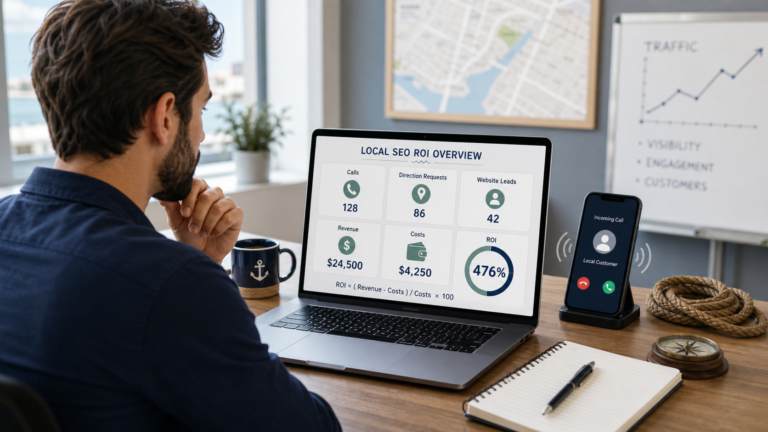
Track calls, website clicks, direction requests, form submissions, and booked leads. Compare branded searches versus discovery searches. Watch which services generate engagement and whether certain locations outperform others. If your profile traffic is increasing but leads are flat, the issue may be conversion rather than visibility.
For busy owners, this is where expert help can save a lot of time. A good local SEO partner should not bury you in vanity metrics. They should show what changed, why it matters, and whether it is driving business outcomes.
If managing all of this feels like one more job you do not need, that is a fair reaction. Google Business Profile optimization is simple in theory and time-consuming in practice. The good news is that steady, compliant improvements usually outperform shortcuts. Start with accuracy, build trust signals, keep the profile active, and make every section easier for a customer to choose you.