A business can rank well in local results for years, then suddenly see fewer calls while search impressions still look fine. That is the kind of shift many owners are starting to notice as the AI search impact on local SEO becomes more visible. Search is no longer just a list of ten blue links and a map pack. It is becoming an answer engine, and that changes how local businesses get found.
For small business owners, the main question is not whether AI is changing search. It already is. The real question is whether your local presence gives Google and other platforms enough clear, trustworthy signals to recommend your business when users ask more specific, conversational questions.
What the AI search impact on local SEO actually means
AI search changes the way platforms interpret intent and assemble answers. Instead of only matching a search like plumber near me to nearby business listings, search engines are getting better at handling longer questions such as who fixes tankless water heaters in Scottsdale and offers weekend service. That sounds small, but it has major consequences.
In older search behavior, ranking factors often appeared in cleaner buckets. Your Google Business Profile mattered for Maps. Your website mattered for organic search. Reviews helped trust. Citations helped consistency. Those things still matter, but AI systems are more likely to combine them into a broader judgment about whether your business is the best answer.
That means local SEO is becoming less about isolated tactics and more about overall credibility. If your business hours are outdated, your service pages are thin, your reviews are vague, and your service area is unclear, AI-driven search systems have less confidence in your relevance. If your profile, website, reviews, and business details all support the same story, your chances improve.
Why local businesses should pay attention now
This is not just a trend for national brands or tech companies. Local businesses may feel the changes faster because local searches often lead directly to phone calls, direction requests, bookings, and quote requests. Even a modest drop in visibility can hit revenue.
AI-generated search results can reduce clicks for some businesses while increasing clicks for others. If an AI answer names a business, highlights its strengths, or pulls from well-structured local content, that business can gain attention quickly. If your business is missing from that answer layer, you may lose traffic even if you still technically rank somewhere on the page.
There is also a trust factor. Search engines want to recommend businesses that appear real, active, and dependable. For a local company, that trust is built through familiar signals: accurate contact information, complete service descriptions, recent reviews, strong website content, location relevance, and a properly optimized Google Business Profile.
The local ranking signals AI still relies on
Some business owners hear AI search and assume the old local SEO basics are now outdated. That would be a mistake. In most cases, AI search raises the value of doing the basics well.
Google still needs clear business data. Your name, address, phone number, hours, categories, and service areas still matter because they help platforms understand who you are and where you operate. If that information is inconsistent across your website, Google Business Profile, and directory listings, you create unnecessary confusion.
Website content still matters because AI systems need context. A generic homepage that says quality service at competitive prices does not give search engines much to work with. A detailed service page that explains what you do, where you do it, and how customers can take the next step gives stronger relevance signals.
Reviews may matter even more now because they contain natural language. A review that says this company helped us replace a broken AC unit the same day in downtown Tampa provides useful context about service type, responsiveness, and geography. AI systems are built to interpret language, so detailed reviews can reinforce local relevance in ways star ratings alone cannot.
How AI search changes customer behavior
One of the biggest shifts is not technical. It is behavioral. People are asking search engines more detailed questions, and they expect quicker answers.
Instead of searching dentist Chicago, a user may ask which dentist near Lincoln Park is good with nervous patients and accepts same-week appointments. Instead of searching roofer near me, they may ask who repairs storm damage on asphalt shingle roofs in my ZIP code. Those queries are more specific, more urgent, and often closer to conversion.
That is good news for local businesses that have strong, specific content. It is less helpful for businesses relying on thin location pages, outdated profiles, or broad generic copy. AI search rewards clarity. If your website and local profiles make it easy to understand your services, service area, specialties, and proof of quality, you are in a better position.
What small businesses should do next
The response to AI search should be practical, not panicked. Most local businesses do not need a complete reinvention. They need cleaner signals, stronger content, and better consistency.
Start with your Google Business Profile. Make sure your primary category is correct, your services are filled out, your business description is accurate, your hours are current, and your photos are recent. Publish updates when they are relevant, and keep answering questions and responding to reviews. This profile remains one of the clearest local trust signals available.
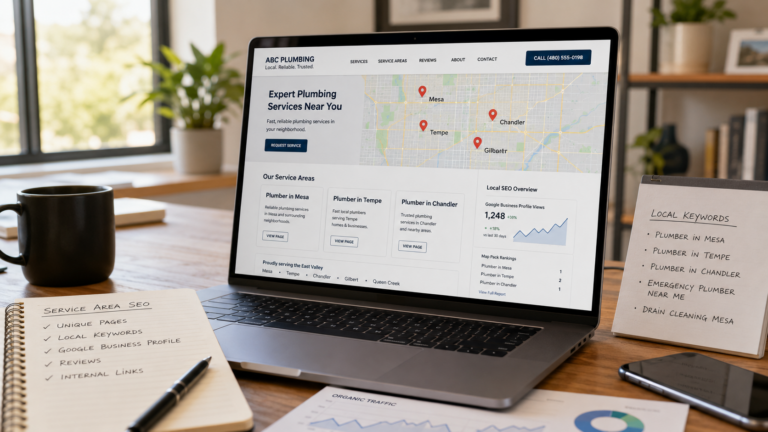
Then look at your website through the lens of a customer asking a very specific question. Do you have dedicated pages for your key services? Do those pages mention the cities or areas you actually serve? Do they explain real problems you solve, not just broad marketing claims? Search engines need specifics, and so do customers.
Next, review your local landing pages. Many businesses have city pages that are too thin to be useful. If every page is nearly identical except for the town name, that is not helping much. A stronger page explains the service in that market, references local relevance naturally, and gives the visitor a clear reason to contact you.
Reviews deserve a more deliberate process too. Do not just ask for more reviews. Ask for better reviews. Encourage customers to mention the service they received, the location, and what stood out. You should never script reviews, but you can guide customers toward useful detail.
Finally, check your citations and directory profiles. AI search may feel advanced, but it still depends on reliable source data. If your listings are inconsistent, incomplete, or neglected, they weaken your overall local authority.
The trade-offs business owners should understand
Not every AI search change will help local businesses equally. In some cases, AI answers may keep users on the search results page longer, which can reduce website clicks. That does not always mean performance is worse. If more people call directly from your profile or request directions without visiting your site, the lead still counts.
There is also a difference between visibility and attribution. A business may benefit from stronger brand exposure through AI-generated answers, but that impact may not show neatly in analytics. This is why local SEO reporting should track more than rankings alone. Calls, form fills, direction requests, and engaged traffic matter more than a vanity spike in impressions.
Another trade-off is speed. AI search is evolving quickly, but local trust is still built slowly. There is no shortcut around reputation, accurate data, and useful content. Businesses looking for instant tricks usually end up with inconsistent results or risky tactics that do not last.
A smarter way to think about AI search impact on local SEO
The best way to view this shift is simple: AI is making local search more interpretive. Search engines are trying harder to decide which business best fits a user’s exact need, not just which page contains the right phrase.
That favors businesses with a strong digital footprint across multiple channels. It favors operators who keep their information current, publish useful content, collect meaningful reviews, and make their service area obvious. It favors businesses that look trustworthy everywhere a customer or search engine might check.
For busy owners, that can feel like one more thing on an already full plate. But this is also where the opportunity is. Many competitors still have weak profiles, neglected local pages, and scattered business data. A business that gets the fundamentals right now can gain ground while others are still trying to figure out what changed.
At Nautical Agency, we see the same pattern again and again. The businesses that win local visibility are usually not the loudest. They are the clearest, the most consistent, and the easiest for search engines to trust.
If AI search keeps moving toward better answers, local businesses should do the same. Be the obvious answer in your market, and your SEO will have a much better chance of turning visibility into real leads.