When your business does great work but still barely shows up in Google Maps or local search results, the problem usually is not effort. It is usually clarity. Google needs clear signals about what you do, where you do it, and why your business is the best local result to show.
That is the heart of how to improve local search visibility. It is not one trick, one tool, or one listing. It is the combined effect of a properly optimized Google Business Profile, a website that supports local intent, consistent business information across the web, and enough authority signals to help Google trust your business over nearby competitors.
How to improve local search visibility starts with Google Business Profile
For most small businesses, your Google Business Profile is the single most important local SEO asset you have. It influences whether you appear in Google Maps, the local pack, branded search results, and direction-based searches from nearby customers.
A half-complete profile puts you at a disadvantage. You want the basics right first: the exact business name you use in the real world, the correct primary category, relevant secondary categories, accurate hours, a working phone number, and a real business description written for humans rather than stuffed with keywords.
Photos matter more than many owners expect. If two businesses offer the same service and one profile looks active, current, and trustworthy while the other has three old photos and missing details, the stronger profile often wins more clicks. Google wants to show businesses that look legitimate and useful.
There is also a trade-off with categories and services. More is not always better. If you add every possible category or service just to cast a wide net, you can dilute relevance. It is usually smarter to be precise about your highest-value services and the locations you actually serve.
Your website has to back up your local relevance
Google Business Profile can get you visibility, but your website often determines whether that visibility turns into rankings and leads. If your site is thin, outdated, slow, or vague about your service area, local performance usually stalls.
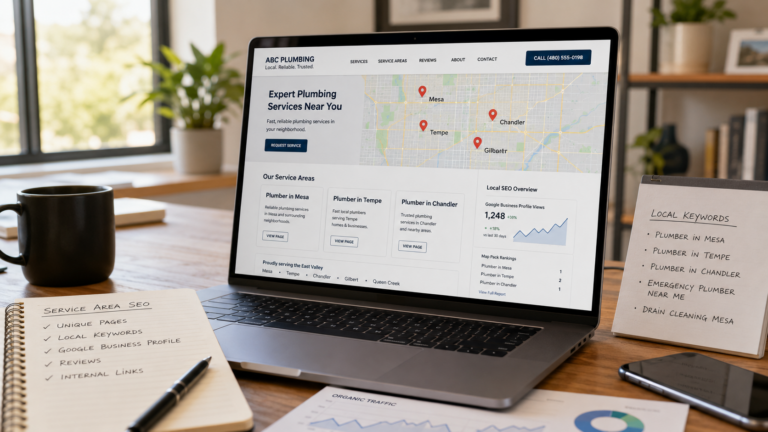
Start with your core pages. Every main service should have its own page, and those pages should clearly explain what you offer, who it is for, and where you provide it. If you are a plumber, roofer, lawyer, dentist, or landscaper serving multiple towns, one generic services page is rarely enough.
Location pages can help, but only when they are done well. This is where many businesses get it wrong. They create near-duplicate city pages that swap out town names and add no useful content. That can look weak to both search engines and potential customers.
A strong location page is specific. It speaks to the service in that area, references the actual geography, addresses common local problems, and gives a customer a clear reason to call. If you serve customers at their homes or businesses rather than from a storefront, your service area still needs to be reflected naturally on the site.
Your contact page also matters. Make sure your business name, address, and phone number are easy to find and match what appears on your Google Business Profile and major directory listings. In local SEO, inconsistency creates friction.
Reviews are a ranking factor and a conversion factor
If you want to know how to improve local search visibility in a way that also increases leads, reviews belong near the top of the list. They help Google understand prominence, and they help searchers decide whether to trust you.
The best review strategy is consistent, simple, and operational. Ask after a job is completed, after a customer says thank you, or after you know the outcome was positive. Do not wait until you “have time” to build a process. Businesses that steadily collect reviews usually outperform businesses that ask in bursts and then go silent for months.
The content of reviews matters too. Natural mentions of services, neighborhoods, responsiveness, and quality can strengthen relevance. You cannot script reviews, and you should never incentivize or fake them, but you can make it easy for satisfied customers to leave honest feedback.
Responding to reviews is worth the extra few minutes. It shows activity, signals professionalism, and gives you another chance to reinforce your services and location naturally. A thoughtful response to a negative review can also reduce damage and show future customers how you handle problems.
Citations help Google trust your business information
Citations are mentions of your business name, address, phone number, and other core details across directories and local listing sites. They are not the flashy part of SEO, but they are foundational.
If one site lists your old phone number, another has the wrong suite number, and a third uses a different business name variation, you create confusion. That confusion can weaken trust and local visibility.
The goal is not to be listed everywhere. The goal is to be accurate in the places that matter. Major data sources, key industry directories, local chamber or community listings, and well-known map and business platforms carry more value than random low-quality directories.
For multi-location businesses, citation management gets more complex. Each location needs its own clean, consistent footprint. That takes process and attention to detail. It is one reason local SEO can feel frustrating for owners trying to manage everything themselves.
Local authority still matters
Even with a strong profile and a clean website, some businesses hit a ceiling because competitors have stronger authority. In local SEO, that often comes from backlinks, local mentions, branded searches, and a history of trust signals over time.
That does not mean you need a huge PR campaign. It means your business benefits from credible mentions on relevant local and industry websites. Sponsorships, partnerships, associations, vendor pages, local media mentions, and community involvement can all contribute when they are real and earned.
White-hat link building works best when it is tied to your business operations. A contractor might earn mentions from suppliers or project features. A law firm might be listed in respected legal directories and local organizations. A home service business might get visibility from neighborhood publications or community partnerships.
There is a patience factor here. Authority usually builds slower than profile edits or on-page improvements. But it often makes the difference in competitive markets where several businesses have already covered the basics.
Behavior signals come from better user experience
Local SEO is not just about getting seen. It is about getting chosen. If people find your listing or website and quickly bounce, Google gets weaker engagement signals and you get fewer leads.
That is why practical website improvements matter. Fast load times, mobile-friendly design, click-to-call functionality, visible service areas, and clear calls to action all help. If a customer has to hunt for your phone number or cannot tell whether you serve their town, you lose momentum.
The same goes for your Google Business Profile. Keeping hours updated, posting recent photos, answering common questions, and making your services clear can improve how people interact with your listing. Better engagement does not replace core SEO work, but it supports it.
Track leads, not just rankings
One of the most common mistakes in local SEO is focusing only on position reports. Rankings matter, but they are not the full story. A business can rank for low-value terms and still struggle to generate calls. Another can improve maps visibility in a few high-intent areas and see a meaningful jump in leads.
If you want local SEO to support growth, track the actions that matter: phone calls, contact form submissions, direction requests, booked appointments, and qualified leads by service area. This is where transparency matters. You should be able to see what is improving, what is flat, and what still needs work.
This is also where expectations need to stay realistic. Some changes can produce movement in weeks. Others take months, especially in crowded markets or after years of inconsistent SEO. The right question is not whether local SEO works overnight. It is whether the work is moving your business toward more visibility in the places customers actually search.
The businesses that win locally are usually the most consistent
If local search feels confusing, that is because there are a lot of moving parts. But the businesses that improve visibility usually do not win by chasing hacks. They win by making their business easier for Google to understand and easier for customers to trust.
That means keeping your Google Business Profile active, building service and location pages that reflect real demand, earning steady reviews, cleaning up citations, strengthening authority, and measuring results against actual leads. For busy owners, that can be hard to manage alone. That is why agencies like Nautical Agency focus on doing the work clearly, consistently, and without turning SEO into a black box.
If you are trying to figure out how to improve local search visibility, start with the signals you control and keep going long enough for them to compound. Local search rewards businesses that show up clearly, accurately, and consistently before their competitors do.