If your business is not showing up when nearby customers search, you are not just missing traffic. You are missing calls, booked jobs, walk-ins, and quote requests that are going to competitors. This small business local SEO guide is built for owners who do not have time to sort through vague marketing advice and want a clear path to better visibility in Google Search and Google Maps.
Local SEO is not one tactic. It is a system. Google looks at your business profile, your website, your service areas, your reviews, your business information across the web, and the trust signals pointing back to your domain. If even a few of those pieces are weak or inconsistent, rankings can stall. The good news is that most small businesses do not need flashy campaigns. They need the basics done correctly, consistently, and in the right order.
What a small business local SEO guide should actually help you do
A useful local SEO plan should lead to measurable business outcomes. More visibility matters because it can create more calls, more direction requests, more form submissions, and more qualified leads. If your SEO provider only talks about impressions or broad traffic trends, that is not enough. For a local business, the real question is simple: are more nearby customers finding you and taking action?
That is why local SEO should be treated as an operating system for growth, not a one-time website project. Rankings move when your business becomes easier for Google to verify, understand, and trust. That takes ongoing work, but it does not have to be confusing.
Start with your Google Business Profile
For many small businesses, the Google Business Profile is the most important local asset they have. It often appears before your website and can drive calls and map actions on its own. If it is incomplete, inaccurate, or poorly optimized, your visibility suffers fast.
Start by making sure your business name, primary category, phone number, website, hours, and address or service area are correct. Then strengthen the profile with complete services, business descriptions, high-quality photos, and regular updates. Reviews also matter here, not just the star rating but the consistency and freshness of review activity.
There is some nuance. A plumber with a service area business setup needs a different profile strategy than a retail store with a storefront. A multi-location company also needs tight control over each listing so categories, hours, and location details do not drift. The setup depends on your business model, but accuracy is non-negotiable.
Your website still carries the ranking weight
A strong profile can help you appear in Maps, but your website often does the heavier lifting for organic local rankings. It tells Google what you do, where you do it, and why your business is relevant for specific searches.
Most small business websites are missing obvious local signals. They talk broadly about services but do not clearly mention the towns, cities, or neighborhoods they serve. They bury contact information. They use generic page titles. They load slowly on mobile. These problems are common, and they cost rankings.
Your core service pages should be specific and useful. If you offer roofing in Tampa, lawn care in Mesa, or family dentistry in Columbus, your pages should reflect that plainly. This is where many businesses either go too thin or too aggressive. Thin location pages with swapped city names usually do not perform well long term. On the other hand, trying to force every city into one page makes it harder for both Google and customers to understand your actual service footprint.
The better approach is to build a clean site structure with strong main service pages and, when justified, geographic pages for key service areas. Those pages need original content, clear local relevance, and conversion elements that make it easy for a visitor to call or request an estimate.
Build location relevance without cutting corners
One of the biggest local SEO mistakes is trying to manufacture relevance instead of proving it. Google has become much better at spotting low-value local pages, keyword stuffing, and spammy location tactics.
A better strategy is to create location relevance through real signals. That includes service area pages, city-specific examples of work, localized testimonials when available, clear NAP information, locally relevant schema, and consistent mentions across trusted directories. It also includes content that reflects what customers in a given area are actually searching for.
There is a trade-off here. If you serve 40 towns, you do not necessarily need 40 pages right away. Start with the markets that matter most to revenue, proximity, and competitive opportunity. Expand from there based on performance, not guesswork.
Citations and directories still matter, but only when managed well
Citations are mentions of your business name, address, phone number, and related details across business directories and local platforms. They are not the most glamorous part of SEO, but they still help validate your business information.
The key is consistency. If one site lists an old phone number, another has the wrong suite number, and a third uses a different business name variation, trust gets diluted. That confusion can affect rankings and create friction for customers trying to reach you.
You do not need to chase every directory on the internet. Focus on the major data sources, trusted core platforms, and relevant industry or local directories. Quality beats volume. A handful of accurate, authoritative profiles is more useful than dozens of neglected listings.
Reviews influence more than reputation
Reviews are often treated as a reputation issue only, but they also support local SEO performance. They can improve click-through rates, reinforce trust, and send strong business quality signals to Google.
The best review strategy is simple and repeatable. Ask happy customers consistently. Make the process easy. Respond professionally. Do not buy reviews or pressure customers into wording them a certain way. Google wants authentic feedback, and so do future customers.
A business with 35 recent, legitimate reviews will often look stronger than one with 200 old reviews and no recent activity. Freshness matters. Response quality matters too. If customers mention specific services or locations naturally in reviews, that can support relevance, but it should happen organically.
Local links still help separate you from competitors
If your Google Business Profile and website are in decent shape, local links can become a real differentiator. These are links and mentions from relevant local organizations, chambers, publications, sponsorships, associations, and community partners.
This is where white-hat SEO matters. Good local link building is earned through relevance and credibility, not through bulk link packages or paid schemes that create risk later. For many small businesses, even a modest number of solid local links can move the needle because competitors are often doing none of this well.
It does depend on your market. In a smaller town, citation consistency and a strong profile may get you far. In a dense metro area with aggressive competitors, authority signals from local links can matter much more.
Track leads, not just rankings
Rankings are useful, but they are not the whole story. A top position that does not produce calls has limited value. A page ranking third for a high-intent search that drives quote requests may be far more important than a page ranking first for a broad term.
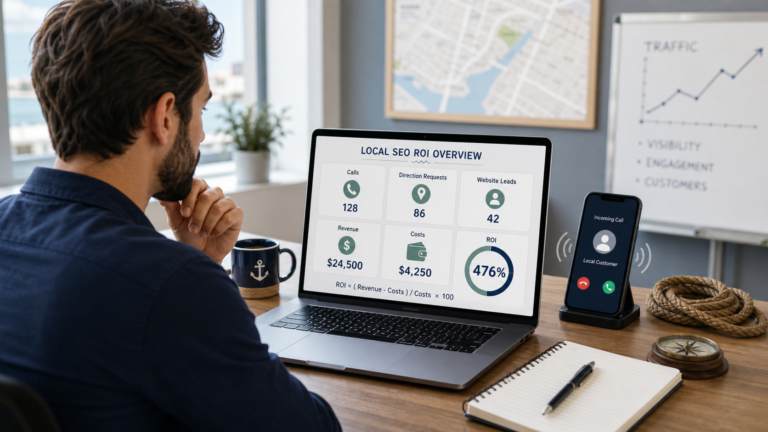
That is why local SEO should be tied to reporting that shows real outcomes. Track phone calls, form submissions, direction requests, website traffic by location, and visibility trends in your priority markets. This gives you a clear read on whether the work is producing business growth or just activity.
For busy owners, transparency matters here. You should not need to decode a spreadsheet full of vanity metrics to understand whether your investment is working.
The right local SEO pace for a small business
Most small businesses do not need a massive rollout on day one. They need a smart sequence. Usually that means cleaning up the Google Business Profile, fixing website fundamentals, correcting citation issues, improving key service and location pages, then building reviews and authority over time.
Local SEO is not instant, and anyone promising overnight domination is selling fantasy. But it should not feel mysterious either. With steady monthly work, clean reporting, and a strategy built around your service areas and lead goals, local growth becomes much more predictable.
If you are trying to handle all of this while running payroll, serving customers, and keeping the phones answered, getting expert help can save time and prevent expensive mistakes. That is the role Nautical Agency is built to play – simplifying local SEO for small businesses that need better visibility without the usual runaround.
The best time to fix your local presence is before the next customer searches, not after they hire someone else.