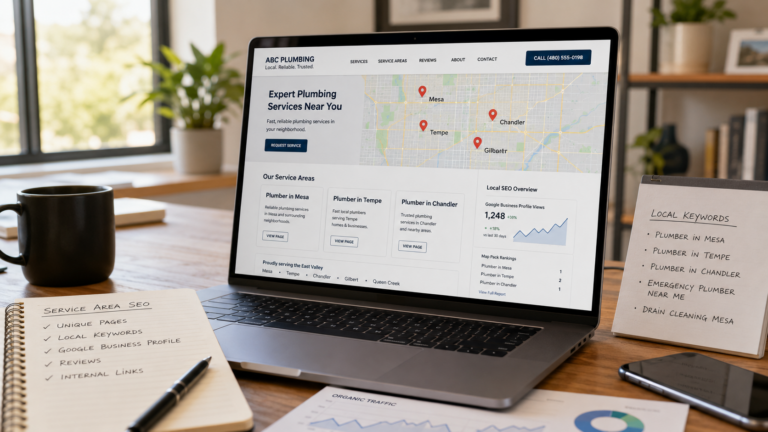
If your business shows up three towns away but not in the city you actually serve, you already know why people ask, what does local SEO include? It is not one fix, one listing, or one blog post. Local SEO is the combined work that helps your business appear in Google Search, Google Maps, and other local discovery results when nearby customers are ready to call, visit, or book.
For small business owners, that matters because local search is usually bottom-of-funnel traffic. These are not casual browsers. They are typing things like plumber near me, emergency dentist in Tampa, or best pizza in Round Rock because they need something now. If your presence is incomplete, inconsistent, or weaker than a competitor’s, Google has less reason to put you in front of them.
What does local SEO include in practice?
Local SEO includes several moving parts that work together. The short version is this: your Google Business Profile, your website, your location signals across the web, your reviews, and your reporting all need to support the same story about who you are, where you operate, and why customers should trust you.
That sounds simple, but the details matter. A well-optimized Google Business Profile without a strong website can stall out. A solid website with messy directory listings can send mixed signals. Great rankings without lead tracking can leave you guessing whether any of it is working.
Google Business Profile optimization
For most local businesses, Google Business Profile is the center of local visibility. It influences whether you appear in the map pack, how your business looks in branded search results, and what information customers see before they ever click your website.
A proper optimization goes beyond claiming the profile. It includes choosing the right primary and secondary categories, writing a clear business description, setting accurate service areas or location details, uploading quality photos, publishing updates when appropriate, and making sure hours, services, and contact information are correct.
It also includes ongoing management. Profiles drift over time. Hours change, services expand, competitors get more active, and Google suggests edits. If nobody is watching, a strong profile can quietly become outdated.
There is also a compliance angle here. Shortcuts, keyword stuffing, and fake location tactics may create a temporary bump, but they create risk too. For a small business that depends on local leads, a suspension or profile issue is not a small inconvenience. It can hit revenue fast.
Website optimization for local intent
Your website still does heavy lifting in local SEO. Google uses it to confirm relevance, service offerings, location details, and trust signals. Customers use it to decide whether you look credible enough to contact.
This usually starts with the basics: title tags, headings, on-page copy, internal structure, mobile usability, and page speed. But local website SEO also needs clear geographic targeting. If you serve specific towns, cities, or neighborhoods, your site should reflect that naturally and accurately.
For some businesses, that means city pages or service area pages. For others, it means strengthening location pages for each office. The right approach depends on your business model. A law firm with staffed offices has different needs than a garage door company that travels to customers across a metro area.
The trade-off is worth calling out. More pages are not automatically better. Thin, duplicated city pages usually do not help much and can make the site weaker overall. Good local pages need useful, specific content that matches real search demand and real business coverage.
Consistent business listings and citations
Another core part of what local SEO includes is citation work. That means building, correcting, and maintaining your business information across directories, map platforms, and relevant industry profiles.
The big issue here is consistency. Your business name, address, phone number, website, and categories should line up across the web as much as possible. If one site has an old phone number, another has the wrong suite number, and a third lists a different business name variation, those inconsistencies can dilute trust.
Citations are not magic by themselves, and they are not equally valuable on every platform. A local business does not need to chase every directory on the internet. It needs accurate placement where customers and search engines are likely to look, plus coverage in relevant local and niche sources.
For multi-location businesses, this gets more operational. Each location needs its own clean footprint. That takes process, especially if locations have changed phone numbers, moved, or inherited messy listings from past marketing vendors.
Reviews and reputation signals
Reviews are part of local SEO because they influence both visibility and conversion. A strong review profile sends trust signals to Google, but more importantly, it helps real people choose you over the business next to you.
This is not about gaming the system. It is about consistently earning reviews from actual customers and responding to them in a way that shows the business is active and accountable. Quantity matters, but so do recency, quality, and relevance.
A business with 120 reviews from three years ago may look less dependable than one with 60 reviews and a steady stream of recent feedback. Context matters too. A roofing company, med spa, and auto repair shop all need reviews, but the language customers use and the concerns they mention can be very different.
If review generation is treated as an occasional push, results usually flatten out. The businesses that do best tend to build it into normal operations so requests happen consistently after real service milestones.
Local content and geographic relevance
Local SEO often includes content creation, but not content for content’s sake. The goal is to build pages and articles that support how people actually search in your market.
That may include service pages, location pages, FAQs, and supporting content around common local questions. A family law attorney might need pages tailored to key practice areas in specific counties. A pest control company might benefit from content tied to seasonal issues in the cities it serves. A home services brand may need pages that explain what is offered in each service area and what makes the business a fit for that market.
The best local content is specific enough to be useful and restrained enough to stay credible. When every city page says the same thing with the town name swapped in, customers notice and search engines do too.
Local link building and authority
Links still matter, including in local SEO. They help search engines understand that your business is legitimate, referenced, and connected to the community or industry.
What local SEO includes here is usually white-hat link acquisition through legitimate relationships and placements. That can mean local sponsorships, chambers, associations, local media mentions, relevant business organizations, and quality content that earns attention. For some industries, niche links matter even more than general local ones.
This is another area where shortcuts cause problems. Low-quality link packages may look appealing because they sound fast and cheap, but they rarely create durable results. Small businesses usually benefit more from fewer, better links than a pile of questionable ones.
Analytics, calls, and real lead tracking
One of the most overlooked parts of local SEO is measurement. Rankings matter, but rankings alone do not tell you whether the work is paying off.
A complete local SEO program should include analytics setup, call tracking when appropriate, form tracking, Google Business Profile insights, and reporting that connects search visibility to business outcomes. That is how you separate activity from results.
This matters because local SEO can succeed in different ways depending on the business. Some companies get more calls straight from Google Maps without many website visits. Others generate most leads through service pages on the website. Some need direction requests and foot traffic. Others care about booked estimates. A good strategy measures what actually moves revenue.
Technical cleanup behind the scenes
There is also technical work involved, even if customers never see it. This can include schema markup, crawl issues, duplicate location pages, redirect problems, indexation cleanup, and mobile performance improvements.
Not every local business needs deep technical SEO every month, but most sites have something that needs attention. A slow mobile site, broken contact forms, or location pages Google cannot properly crawl will undercut everything else.
This is where a lot of owners get frustrated. They can tell something is off, but they do not have time to sort through platform settings, plugins, page templates, and tracking problems. That is why local SEO works best when the strategic and technical sides are handled together instead of in isolation.
Why local SEO is ongoing, not one-and-done
If you were hoping local SEO included a single setup and then permanent rankings, that is the one part nobody likes hearing. Competitors keep optimizing. Reviews keep changing. Search behavior shifts. Google updates features, filters, and ranking patterns all the time.
That does not mean local SEO has to feel complicated. It means the work needs a steady process. The businesses that win locally are usually the ones that keep their profiles accurate, their website useful, their reputation active, and their reporting honest.
For busy owners, the real question is not just what does local SEO include. It is whether each piece is being done well enough to create more calls, more direction requests, and more qualified leads in the places that matter most. If local SEO is making your business easier to find and easier to trust, it is doing its job. If it is only generating dashboards and jargon, it is time to simplify the plan and focus on what actually brings customers through the door.