Most small businesses do not have a Google problem. They have a visibility problem. If you are trying to figure out how to optimize Google Business Page performance, the goal is not to make the profile look nicer. The goal is to help more local customers find you, trust you, and contact you before they call a competitor.
That distinction matters because Google Business Profile is not a set-it-and-forget-it listing. It is a local ranking asset. It influences how often you appear in Google Maps, how credible you look in search results, and whether a searcher decides to call, click, or keep scrolling. For service businesses and local storefronts, a well-optimized profile can produce leads without requiring a full website rebuild or a huge ad budget.
What actually moves a Google Business Profile
Business owners are often told to add a few photos, ask for reviews, and move on. Those things help, but they are only part of the picture. Google looks at relevance, distance, and prominence. You cannot control distance, but you can improve how clearly your profile matches what people search for and how trustworthy your business appears.
That means your profile needs accurate business data, strong category targeting, complete services, recent activity, consistent review generation, and alignment with your website and directory listings. If one of those pieces is off, the profile can still rank, but usually not as consistently as it should.
How to optimize Google Business Page settings the right way
Start with the basics, because weak fundamentals create problems later. Your business name should be your real-world business name, not a list of keywords. Adding extra terms may seem like a shortcut, but it can trigger suspensions or edits and create trust issues.
Your primary category is one of the biggest ranking signals in the profile. Choose the category that best matches your core service, not a broad label that feels safer. A personal injury lawyer should not default to law firm if personal injury attorney is available and accurate. A plumber should not choose contractor just because it sounds general enough to cover everything.
Secondary categories should support the main category, not compete with it. If you are a roofing company that also handles gutters and siding, those supporting categories may be useful if they reflect real services. If they do not, leave them out. More categories are not always better.
Your address and service area also need careful handling. If customers visit your location during stated hours, use the full address. If you operate as a service-area business, hide the address and define the service area properly. Do not try to do both in a way that misrepresents how the business operates. That is one of the fastest ways to create compliance problems.
Fill out the profile like a local buyer is checking it
A complete profile tends to perform better because it gives Google and searchers more context. Business hours should be accurate, including holiday hours. Phone numbers should connect directly to the business. The website field should point to the most relevant page, which is often the homepage for a single-location business and a location page for a multi-location business.
The business description is not the place for keyword stuffing. Write it in plain English. Explain what you do, who you serve, and what makes your business useful or credible. Think like a customer deciding between three local options in under a minute.
Services and products matter more than many owners realize. They help Google understand what the business offers and they help searchers confirm they are in the right place. Add real services with clear names and short descriptions. If your industry supports product listings, use them, but keep them accurate and updated.
Attributes can also improve conversion. Things like veteran-owned, women-owned, appointment required, or wheelchair accessible may not transform rankings on their own, but they can affect whether someone chooses your listing over another one.
Reviews are a ranking signal and a conversion signal
If you want better local visibility, reviews cannot be occasional. They need to be part of your operating process. Quantity matters, but quality and recency matter too. A profile with 150 reviews from three years ago is not as strong as one with a steady flow of recent, detailed feedback.
Ask for reviews at the right moment, usually after a completed job, successful appointment, or positive customer interaction. Make it easy. The best review systems are simple enough that your team actually uses them.
Responding to reviews is part of optimization, not just customer service. Thank customers by name when appropriate, mention the service naturally, and keep the tone professional. For negative reviews, avoid defensiveness. Address the concern calmly and show that the business takes problems seriously. Prospective customers read those replies.
There is also a trade-off here. Some owners push hard for reviews and end up with awkward or low-quality feedback. It is better to build a steady review process than to force a one-week spike that does not last.
Photos, posts, and activity help keep the profile alive
Google favors profiles that show signs of real business activity. That does not mean you need to post every day, but stale profiles tend to lose momentum over time. Fresh photos are one of the easiest ways to keep the listing active and credible.
Upload real photos of your team, work, vehicles, storefront, interior, equipment, and completed projects when relevant. Avoid overproduced stock-style images. Local customers want proof that your business exists and does the work you say it does.
Google Posts can support that effort if you use them practically. Promotions, seasonal offers, service highlights, event announcements, and short updates can all be useful. The point is not to treat posts like social media content. The point is to show recent business activity and reinforce key services.
Questions and answers deserve attention too. If your profile has unanswered questions, fix that. In some cases, it makes sense to seed common questions yourself and answer them clearly, especially for service-area businesses with pricing, travel, or scheduling questions.
Your website and citations still affect the profile
A Google Business Profile does not operate in isolation. If your website sends weak signals, your profile often underperforms. The business name, address, phone number, service areas, and primary offerings should match across your website and major directory listings.
If Google sees conflicting information across the web, trust drops. Rankings may become unstable. This is especially common after rebrands, phone number changes, office moves, or when businesses use different address formats in different places.
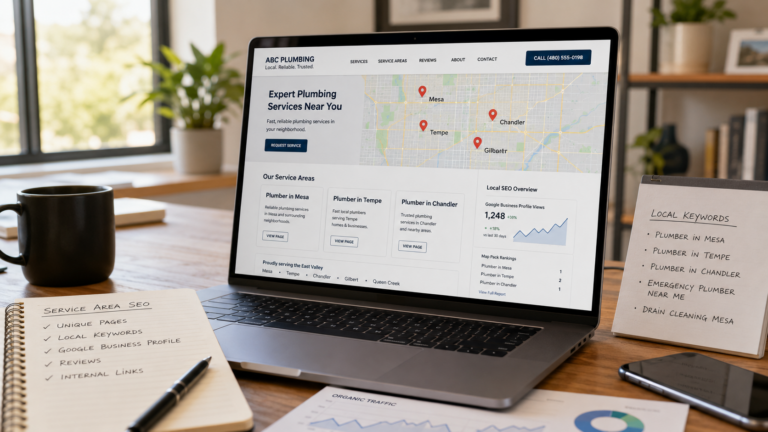
Location pages are important for multi-location companies, and they help single-location businesses too when built well. A good location page reinforces exactly where you operate, what services you provide there, and how customers can contact you. That gives your profile stronger local support.
This is where many small businesses get frustrated. They update the Google profile but ignore the website and citations behind it. Then they wonder why results stall. Local SEO usually works best when those assets are aligned.
Track actions, not just rankings
A profile that ranks well but does not produce calls is not doing its job. You should watch the actions that matter: calls, website clicks, direction requests, bookings, and form leads tied to local traffic. Rankings are useful, but they are only one part of the picture.
It also helps to look at search behavior. Are people finding you for branded searches only, or are you showing up for non-branded services in your market? That difference tells you whether the profile is just capturing existing awareness or helping you win new demand.
Optimization is rarely a one-time fix. Categories change. Competitors get more active. Reviews slow down. Photos get outdated. Spam listings appear. A strong profile needs ongoing maintenance, even if that maintenance is fairly light month to month.
For busy owners, that is usually the real issue. Not understanding what to do is only half the problem. Having the time to do it consistently is the other half. That is why a lot of local businesses eventually hand this work off to specialists who can manage the details, keep the profile compliant, and tie the effort back to leads instead of vanity metrics.
If you are serious about local growth, treat your Google Business Profile like a sales channel, not a directory listing. The businesses that show up more often and convert more searchers are usually the ones that keep it accurate, active, and closely connected to the rest of their local SEO. A few steady improvements now can turn into a lot more calls later.