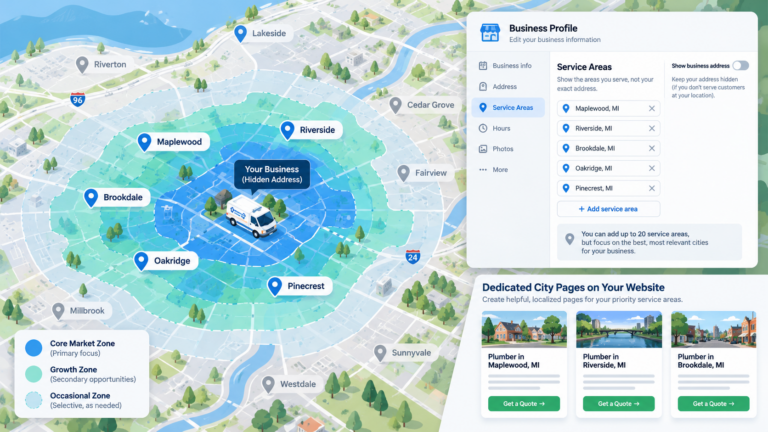
A plumber can serve 20 towns without having an office in every one. The same is true for roofers, cleaners, landscapers, HVAC companies, mobile pet groomers, and many other local businesses. This guide to service area SEO explains how to show up where customers actually search without creating thin pages, misleading Google, or wasting time on tactics that never produce calls.
Service area SEO is not about claiming every city on a map. It is about giving Google and prospective customers clear, consistent proof of where you work, what you do there, and why your business is a legitimate choice.
What service area SEO is really designed to do
Service area SEO helps businesses that travel to customers compete in Google Search and Google Maps across the cities, suburbs, and neighborhoods they serve. A customer may search for “emergency electrician near me” in one town and “panel upgrade electrician” in the next. Your job is to make it easy for Google to connect your business with both searches when you can genuinely serve those customers.
For a storefront, local visibility is often anchored to one physical address. For a service-area business, the work is more nuanced. Your Google Business Profile, website, reviews, directory listings, and local signals all need to tell the same story about your services and coverage area.
The goal is not traffic for its own sake. The goal is more qualified calls, form submissions, quote requests, and booked jobs from places your team can profitably serve.
Start with a service area you can support
Before building pages or adjusting a profile, define your real service territory. Start with the locations you can reach consistently, the jobs that make financial sense, and the areas where you have capacity to respond quickly. A 60-mile radius may look impressive on paper, but it can create poor leads if travel time eats into margins or your crews cannot provide dependable service.
Build a working list that separates primary markets from secondary markets. Primary markets are where you want to win first because demand, proximity, job value, or existing reputation is strongest. Secondary markets are nearby areas you can serve but may not need to prioritize immediately.
This decision affects everything that follows: your content plan, ad targeting, review strategy, reporting, and staffing. It also prevents a common mistake: trying to rank in dozens of cities before your website has earned visibility in the markets closest to home.
Set up your Google Business Profile correctly
Google Business Profile is central to Maps visibility. If customers do not visit your location during normal business hours, set the business up as a service-area business and hide the address. Do not use a virtual office, mailbox, employee home, or shared workspace simply to appear closer to another city. That can lead to profile suspensions and lost visibility.
Choose the most accurate primary category for your core service. Categories help Google understand what you do, so this is not a place to be vague. Then add relevant secondary categories only when they reflect services you actually provide.
Add your legitimate service areas, but do not treat that list as a ranking shortcut. Including a city does not guarantee map rankings there. Proximity, relevance, competition, reviews, website signals, and searcher location still matter. Keep your business name, phone number, hours, and service details current. Small inconsistencies create doubt for both customers and search engines.
Build location pages that deserve to rank
A strong service area page gives a customer a useful reason to choose you in that market. A weak page swaps one city name for another and repeats the same 300 words across 30 URLs. Google has become much better at recognizing this pattern, and customers recognize it immediately.
Create location pages for markets that are important enough to warrant real effort. Each page should explain the specific service offered, the types of customer problems you solve, and what the next step looks like. Use natural references to the city, nearby neighborhoods, local property types, seasonal needs, or service considerations when they are genuinely relevant.
For example, an HVAC company serving a coastal area may discuss corrosion concerns from salt air. A roofing contractor in a storm-prone market may explain inspection and emergency tarp services. These details make the page useful because they come from actual operations, not a keyword template.
What each page should include
A useful service area page generally needs a clear service-and-location focus, original copy, proof that your business serves the area, and a direct way to contact you. It should also include related services when helpful, customer reviews or project examples where permitted, and a consistent phone number and call to action.
Do not force a page for every ZIP code, subdivision, or tiny community. It depends on demand and your ability to add distinct value. A business serving three core cities may benefit from three well-developed pages. A regional company with separate crews, proven work, and meaningful search demand may justify a broader content footprint.
Keep navigation practical. Visitors should be able to find your major service areas without digging through an endless city list. Internal links from core service pages to the most important locations help users and give search engines context about your priorities.
Make your website locally credible
Location pages work best when the rest of the site supports them. Your main service pages should clearly explain what you offer, who you help, and how customers can request service. Your contact information should be easy to find, especially on mobile devices where many local searches happen.
Add evidence wherever possible. Real job photos, project descriptions, team credentials, service guarantees, licenses, and customer testimonials can all improve trust. Avoid stock-heavy pages that could describe any company in any city. Local SEO performs better when your website reflects a real business doing real work.
Technical basics matter too. Pages should load quickly, work cleanly on phones, use descriptive page titles, and avoid broken forms or confusing navigation. If a customer cannot call or request an estimate in seconds, rankings alone will not create revenue.
Keep citations and reviews consistent
Google compares information across the web. Your business name, phone number, website, address treatment, and hours should be consistent in major directories, industry platforms, social profiles, and local listings. Inconsistency does not always stop rankings, but it can weaken trust and make it harder for customers to reach you.
Reviews are equally important. Ask for them as part of your normal post-service process, not only when business is slow. A steady stream of honest reviews gives customers current proof that you are active and reliable. Encourage customers to describe the service they received, but never script reviews or offer incentives in exchange for positive feedback.
Respond professionally to reviews, including negative ones. A calm response can show future customers that you take service seriously. It also gives you a practical feedback loop on dispatch, communication, and job quality.
Measure leads by location, not just rankings
Rankings vary based on the searcher’s location, device, search history, and competition. That means a single ranking report cannot tell the whole story. Track the outcomes that matter: calls, form submissions, direction requests when applicable, booked jobs, and revenue by service area.
Use reporting to identify patterns. If one city page attracts traffic but produces few leads, the offer, page content, or service fit may need work. If another city produces strong calls but weak rankings, that may be a market worth investing in with better content, reviews, and local authority.
This is where transparent SEO work earns its value. You should know what is being improved each month, what changed in visibility, and whether those changes are moving the business toward more qualified leads. Vanity metrics are easy to report. Useful reporting connects search activity to decisions you can make.
Common service area SEO mistakes to avoid
The most damaging mistakes usually come from trying to look bigger than the business really is. Avoid fake addresses, keyword-stuffed business names, copied city pages, and service areas you cannot support. These tactics may create a short-term bump, but they put your profile, reputation, and budget at risk.
Another mistake is treating SEO as a one-time setup. Competitors earn new reviews, add content, improve their sites, and expand their own local presence. Your service area strategy needs ongoing attention, especially when services, staffing, coverage, or customer demand changes.
A practical approach wins here: focus first on the markets that matter most, make every profile and page accurate, and improve based on leads rather than assumptions. If managing that work keeps falling behind your daily operations, a hands-on local SEO partner can keep the system moving while you focus on serving customers.
The next customer searching in your best service area does not need a marketing lesson. They need confidence that you serve their location, understand their problem, and can help now. Build your local presence around that moment.