In Part 1 of this series, we discussed how interpreting JavaScript remains a challenge for AI search engines. In Part 2, we explored how AI engines seem to rely heavily on structured data, something Google has become much less dependent on over the years. Now we’re looking at a third area where AI companies still have some catching up to do, and it’s one that directly affects almost every small business owner.
This third area is somewhat related to structured data, but not exactly. It’s your Google Business Profile, and it represents a significant advantage that Google has spent years developing.
Google Has Something AI Companies Are Still Trying to Match
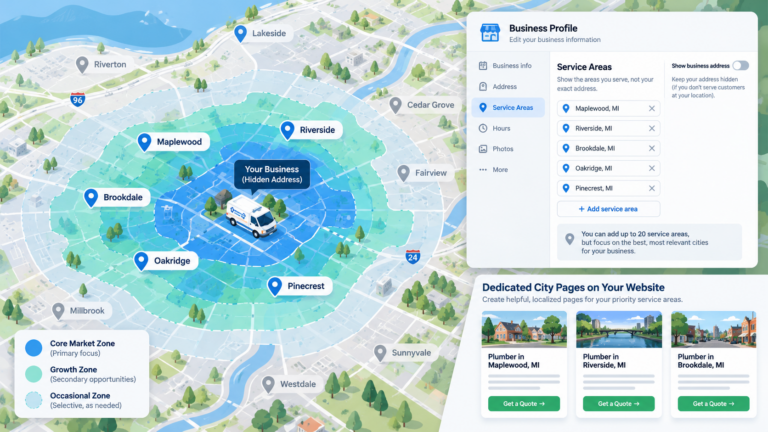
Google gathers information about businesses from websites, online directories, customer reviews, and countless other sources across the internet. However, it also has something particularly valuable: a system that allows business owners to provide information about their companies directly. Through Google Business Profile, businesses can manage important details such as their hours, address, phone number, services, and other information customers need. This is why Google Business Profile optimization remains such an important part of a successful local search strategy.
In a sense, Google is being spoon-fed information about your company, and that’s not necessarily a bad thing. After all, there is one authority that should know more about your business than anyone else, and that is YOU, whether you’re the business owner or the person responsible for marketing. If your business hours change or you move to a new location, it’s simply not acceptable for a search engine to continue displaying outdated information while waiting for hundreds of directories across the internet to catch up.

Google recognized this problem years ago and created a way for businesses to take control of much of their information. Although Google may still verify or update details using other sources, Google Business Profile provides a direct connection between businesses and the search engine that millions of customers use every day.
Where Are AI Search Engines Getting Their Business Information?
This is where AI search companies face an interesting challenge. Platforms such as ChatGPT and other AI-powered search tools are increasingly being used to find local businesses, and in many cases, they’re doing a reasonably good job of returning relevant recommendations. However, the information behind those recommendations can come from a variety of sources, including business websites, third-party data providers, online directories, and search partnerships.
Unlike Google’s established Business Profile system, many AI platforms do not have the same comprehensive, widely adopted process for allowing business owners to directly manage their information. Some have developed local search integrations and structured business results, but the systems vary considerably from one platform to another. This creates the potential for inconsistent information, particularly when businesses change locations, update phone numbers, or adjust their hours.
Consider how many business directories exist across the internet, including Yelp, Yellow Pages, and numerous smaller industry-specific directories. When an AI engine encounters information from several of these sources, it must determine which details are accurate and current. That’s not always straightforward, especially when a business has neglected its online listings for years.
Google’s Local 3-Pack Is Another Advantage
Another area where Google has a considerable head start is the way it organizes and presents local search results. Most people are familiar with Google’s local 3-pack, which typically displays three businesses alongside a map and useful details such as ratings, addresses, hours, and contact information. It’s a simple format that allows consumers to compare businesses quickly without reading through lengthy descriptions.
AI search results can be quite different. Depending on the platform and the question, users may receive several paragraphs discussing recommended businesses, with company names and website links embedded throughout the response. While this conversational approach can be helpful when someone wants detailed recommendations, it isn’t always the most convenient way to compare local businesses at a glance.
Some AI platforms are already introducing maps, business cards, and more organized local search experiences, so this gap is beginning to narrow. Nevertheless, Google has spent years refining its local search interface, and that experience remains an important competitive advantage, particularly for people searching on their phones.
Could AI Companies Eventually Acquire a Business Directory?
One possibility we find particularly interesting is that a major AI company could eventually acquire or establish a significant partnership with an established business directory provider. Rather than spending years assembling a comprehensive database of local businesses, an AI company could potentially gain access to millions of existing business records, including names, addresses, phone numbers, business categories, and other valuable information.
Of course, acquiring a directory wouldn’t automatically solve the problem of inaccurate or outdated listings. A reliable local search system still needs a way for business owners to claim their information, verify that it’s correct, and make updates when something changes. However, as AI-powered search becomes increasingly important on smartphones and other devices, we expect companies to invest more heavily in developing dependable local business information systems.
Whether that happens through acquisitions, partnerships, or entirely new platforms remains to be seen. What seems clear is that AI companies will need to continue improving how they collect, verify, and present local business information if they want to compete effectively with Google.
Why Google Business Profile Optimization Matters More Than Ever
For small business owners, the most important takeaway is that accurate and consistent business information matters across both traditional search engines and AI-powered platforms. Imagine that your company moved to a new location six months ago. You updated your website and Google Business Profile, but several online directories still display your previous address. An AI engine researching your business might encounter two different locations and have to determine which one is correct.
The same situation can occur when a business changes its phone number, adjusts its operating hours, or modifies the services it offers. Although we don’t know precisely how every AI search platform evaluates conflicting business information, inconsistent listings create unnecessary confusion for both search systems and potential customers. Keeping your information accurate across multiple sources makes it easier for people and search engines to identify your business correctly.
This is why we recommend that small businesses claim and fully complete their Google Business Profiles, ensure their websites display matching information, and review their listings across major online directories. Yelp, Bing Places, Apple Business Connect, and relevant industry-specific directories are all worth checking. If you’ve moved, changed phone numbers, or haven’t reviewed your listings in years, correcting outdated information should be a priority.
Make It Easy for Google and AI Search Engines to Find Your Business
Google has spent years developing a system that allows businesses to provide and maintain important information directly, while AI search companies are still evolving their approaches to local business discovery. As these technologies continue to compete, the businesses that make their information easy to find, accurate, and consistent will be better positioned to avoid confusion and help potential customers reach them.
The bottom line is simple: don’t make search engines guess about your business. Your name, address, phone number, hours, and services should be consistent wherever they appear online. Whether someone discovers your company through Google, ChatGPT, or another AI-powered search platform, you want them to receive the correct information the first time.
At Nautical Agency, we help small business owners claim, correct, and optimize their online business listings so their companies are easier to find through both traditional search engines and AI-powered search. Our Google Business Profile optimization services help businesses maintain accurate information and build a stronger foundation for local search visibility.
Whether you’ve recently moved, changed your phone number, or simply haven’t reviewed your business listings in years, we can help you get everything organized and up to date. Small business owners trust Nautical Agency to make optimization for AI and search engines easy.
Contact us today to learn how we can help improve your business’s online visibility.