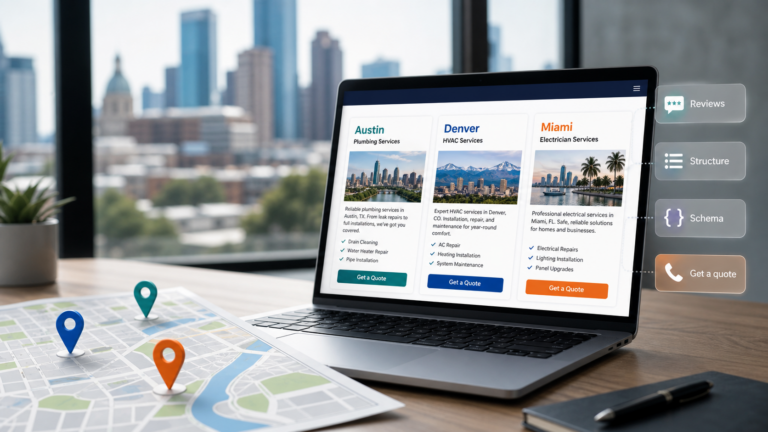
A lot of small business owners ask the same question after looking at their rankings: should you focus on Google Maps or your website rankings? The honest answer in the Google Maps vs organic search debate is that the best lead flow usually comes from both, but they do very different jobs.
If you rely on local customers, this distinction matters. A roofing company, med spa, law office, HVAC contractor, or restaurant can all show up in Google, but where you show up changes how people respond. Some searchers want a fast answer and a phone number. Others want to compare options, read service details, and decide who feels trustworthy. That is why local SEO is not one ranking system. It is two connected visibility channels that influence different parts of the buying decision.
Google Maps vs organic search: what is the difference?
Google Maps results are the local listings tied to a Google Business Profile. These often appear in the map pack near the top of the page for searches with local intent, such as “plumber near me” or “best dentist in Tampa.” They highlight your business name, reviews, hours, category, location, and a path to call, visit, or request directions.
Organic search results are the standard website listings that appear below ads and often below the map pack. These send searchers to pages on your site, such as service pages, city pages, blog content, or location pages. Organic rankings are driven more heavily by website content, site structure, links, and overall SEO authority.
For a busy business owner, the easiest way to think about it is this: Maps is often the quick-decision channel, while organic is often the research and trust-building channel. That is not always true, but it is a useful starting point.
When Google Maps drives better results
If someone needs help now, Maps can win fast. A person with a broken AC unit or a clogged drain is not looking for a long educational article. They want a nearby business with solid reviews, open hours, and a phone number they can tap.
That is why Google Maps often produces high-intent actions. Calls, direction requests, and clicks from the profile can happen with very little friction. The searcher may never visit your website at all.
Maps tends to matter even more for businesses with a physical location or a defined service area. If your business depends on proximity, review quality, and local relevance, your Google Business Profile is a major asset. A weak profile can cost you leads even if your website is strong.
There is a trade-off, though. Maps visibility can be volatile. Small changes in searcher location, competitor reviews, category signals, and profile activity can shift rankings. You also have less room to explain what makes you different. In the map pack, everyone gets a compressed snapshot. If your business model needs more explanation, Maps alone will not carry the full load.
When organic search matters more
Organic rankings give you more control over the story. Your website can explain services, pricing approach, service areas, credentials, financing, FAQs, and what a customer should expect next. That extra context matters when the purchase is expensive, complex, or trust-sensitive.
A criminal defense attorney, cosmetic dentist, remodeling company, or B2B service provider often benefits heavily from organic visibility because people want details before contacting anyone. They compare businesses, read multiple pages, and look for signs of expertise and legitimacy.
Organic search also helps you rank for a wider range of keywords. Your Google Business Profile can only say so much. Your website can target specific services, neighborhoods, cities, and problem-based searches in a way Maps cannot. That makes organic SEO a stronger long-term growth engine for businesses that want to expand beyond a narrow set of local searches.
The catch is timing. Organic SEO usually takes more work and more patience. Strong pages need to be created, improved, and supported with technical cleanup, internal structure, and off-site authority. It is rarely the fastest path to a ranking jump, but it often creates more durable visibility.
Google Maps vs organic search: which gets more leads?
There is no universal winner because lead quality depends on the business type, the market, and the customer journey.
For emergency services and convenience-based businesses, Maps often produces more immediate conversions. People searching for towing, locksmiths, urgent care, pizza, or auto repair are often ready to act. Being visible in the map pack with strong reviews can turn into calls quickly.
For considered purchases, organic search often supports better close rates because the visitor has more time to evaluate your business. A user who lands on a well-built service page and sees the right information may be more qualified than someone who taps the first map listing they see.
In many accounts, the strongest performance comes from overlap. A business appears in Maps, appears organically, and reinforces trust in both places. The searcher sees the profile, sees the website ranking too, and concludes that this company is established. That kind of search dominance can outperform either channel on its own.
Why small businesses should not choose one or the other
This is where many local SEO plans go off track. A business owner gets told to ignore the website and just optimize the Google Business Profile. Or they invest only in website SEO and leave the profile half-complete. Both approaches leave money on the table.
Google uses different signals for Maps and organic rankings, but the systems are connected. A complete, accurate, and active profile supports local relevance. A strong website supports trust, content depth, and geographic targeting. Reviews influence click behavior. Good landing pages improve conversion after the click. Consistent business information across directories helps reinforce legitimacy.
When these pieces work together, local visibility becomes much more stable. If your Maps position drops for a term, organic rankings can still catch demand. If your website is not ranking yet for a new service area, your profile may still generate branded or nearby searches.
That balance matters for risk management, not just growth.
What to prioritize first
If your Google Business Profile is incomplete, inaccurate, or barely managed, fix that first. For many local businesses, there is quicker upside in cleaning up categories, services, business information, photos, review generation, and profile activity than there is in publishing a dozen new website pages.
If your profile is already strong but your website is thin or outdated, organic SEO becomes the bigger opportunity. That usually means improving service pages, building location relevance, tightening technical issues, and making sure the site turns visitors into leads.
If you have multiple locations, the priority becomes consistency and scalability. Each location needs a strong profile, accurate directory signals, and a matching local landing page strategy. Without that structure, visibility becomes uneven from one market to the next.
This is also where transparency matters. You should be able to see what work is being done, what metrics are improving, and whether that growth is turning into calls, forms, and booked jobs. At Nautical Agency, that practical connection between rankings and real leads is the point of the work.
How to think about ROI from both channels
Maps often produces faster visible actions. Organic often produces broader market coverage and stronger trust. The right question is not which one is better in theory. It is which one is underperforming for your business right now, and what fixing it would be worth.
If you are missing out on map pack visibility for your core service, that can hurt every day. If your website does not rank for your most profitable service areas, that can limit growth month after month. The ROI calculation changes based on your margins, your competition, and how customers actually choose providers in your category.
A good local SEO strategy does not force a false choice. It builds the profile, the website, and the supporting signals together in the right order.
The businesses that win local search are usually not the ones chasing one trick. They are the ones showing up where customers look first, and giving those customers enough confidence to take the next step.