If your business is buried in Google Maps, you are losing customers to competitors who are easier to find. That is the real issue behind how to improve Google Maps rankings – not vanity, not bragging rights, but more calls, more direction requests, and more leads from people ready to buy.
For most small businesses, Google Maps visibility is driven by a few controllable factors. Some are tied to your Google Business Profile. Others come from your website, reviews, local citations, and how clearly Google understands where you operate and what you do. The good news is that better rankings usually come from consistent execution, not shortcuts.
How to Improve Google Maps Rankings Without Guessing
Google Maps rankings are often influenced by three core signals: relevance, distance, and prominence. You cannot change a searcher’s location, and you cannot move your office every time rankings shift. What you can do is make your business more relevant to the searches you want, and more prominent than the competition in your area.
That means your optimization work should focus on accuracy, completeness, trust signals, and local authority. If your profile is missing service details, your reviews are weak, your business information is inconsistent across the web, or your website says very little about your city and services, Google has less reason to put you in front of nearby searchers.
Start with your Google Business Profile
Your Google Business Profile is the center of Maps SEO. If it is incomplete or poorly maintained, the rest of your local strategy has a ceiling.
Begin with the basics. Your business name, address, phone number, hours, website, and primary category all need to be accurate. This sounds obvious, but many small businesses hurt themselves here. They use the wrong category, forget holiday hours, or leave outdated phone numbers on older listings. That creates confusion for both users and Google.
Category selection matters more than many owners realize. Your primary category should describe your core service as closely as possible. Secondary categories can support additional offerings, but they should still be relevant. Choosing broad or unrelated categories can dilute your profile instead of helping it.
Then fill out the profile completely. Add services, service areas, business description, products if applicable, and high-quality photos. A strong profile gives Google more context and gives customers more confidence. Both matter.
Reviews are not just about reputation
If you want to know how to improve Google Maps rankings in a way that also improves conversion, reviews should be near the top of the list. They influence trust, and they often support visibility.
The goal is not to get a burst of random reviews and then go quiet for six months. A steady flow is better. Google wants to see signs that your business is active and serving real customers now, not just in the past.
Ask for reviews consistently after completed jobs, purchases, or appointments. Make the process easy. Respond to reviews as they come in, especially detailed ones. Your responses do not need to be long or scripted. They should be professional, human, and specific enough to show engagement.
There is a trade-off here. Aggressive review campaigns can cross the line if you pressure customers, gate feedback, or offer incentives in ways that violate guidelines. The safest approach is simple: ask honestly, ask consistently, and respond thoughtfully.
Your website still affects Google Maps rankings
Some business owners treat Google Maps and their website as separate channels. They are not. A weak site can limit local rankings, especially in competitive markets.
Google uses your website to confirm what your business does and where it does it. If your homepage barely mentions your services or your location, you are asking Google to connect the dots on its own. That is not a strong strategy.
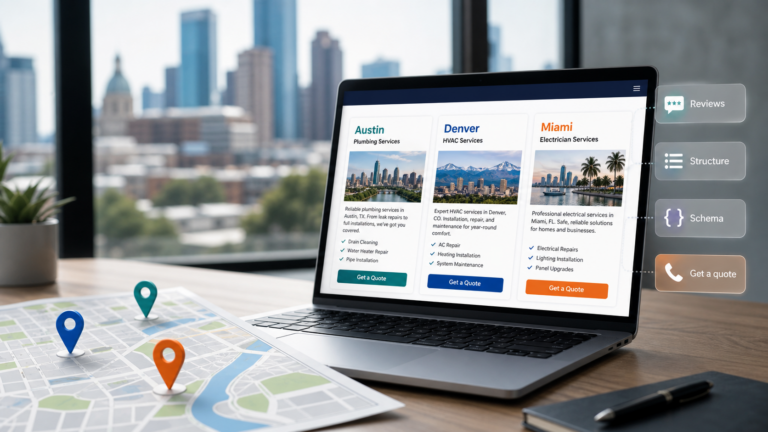
Your site should clearly state your primary services and target locations. If you serve multiple cities, create useful geographic pages that explain what you offer in each area. If you have one main office, make sure your core location is easy to find in title tags, headings, body content, and contact information.
Thin location pages usually do not help. A page with one paragraph and a city name swapped in from another page looks weak to users and search engines alike. A better page explains the service, the area served, common customer needs, and what makes your business a fit for that market.
Local landing pages work best when they earn their place
This is where many companies either overdo it or avoid it entirely. If you operate across several nearby towns, location pages can absolutely support Maps visibility. But they need to reflect real business coverage.
If you are a service-area business, use pages to support the towns you actually serve, not every zip code within a hundred-mile radius. If you have multiple physical locations, each location should have its own page with unique contact details, hours, embedded map context if appropriate, and locally relevant content.
The closer your site matches real-world operations, the easier it is for Google to trust the signals.
Consistency across the web still matters
Your business information appears in directories, data providers, social profiles, chamber listings, and industry platforms. When your name, address, phone number, or website details differ across those sources, local trust can suffer.
That is why citation management still matters. It is not the flashy part of local SEO, but it supports the foundation. Clean up duplicate listings. Fix outdated addresses. Standardize your contact information. Make sure the same business details appear wherever your company is mentioned.
For businesses that moved locations, changed phone numbers, or rebranded, this issue is even more important. Old citations can linger for years and cause unnecessary ranking and conversion problems.
Build prominence with real authority signals
Prominence is where many competitors separate themselves. If two businesses are equally relevant and similarly located, the one with stronger authority often wins.
Authority can come from quality local links, branded mentions, press coverage, strong review signals, and a website that demonstrates expertise. A sponsorship from a legitimate local organization, membership in a respected industry association, or a feature in a local publication can all help reinforce your business’s credibility.
This is also where patience matters. Prominence does not usually spike overnight unless your market is very weak. In competitive cities, authority builds over time through steady work.
Behavioral signals matter more than people think
Google pays attention to how users interact with listings. If people click your profile, call your business, request directions, visit your website, or engage with your photos, that activity can reinforce your profile’s usefulness.
You cannot fake this safely, and you should not try. What you can do is make your listing more compelling. Better photos, complete service details, accurate hours, strong reviews, and a clear business description all improve the chances that searchers choose you.
Posting updates can help as well, especially if you have promotions, seasonal services, or timely business news. Posts are not a magic ranking lever, but they can keep your profile active and useful.
How to improve Google Maps rankings in competitive markets
In less competitive towns, basic optimization can move the needle quickly. In larger cities or crowded service categories, the bar is higher.
If ten nearby competitors all have decent profiles, then small differences matter. Review quality matters, not just review count. Category strategy matters. Site content quality matters. Link quality matters. Even photo freshness and profile completeness can affect click behavior enough to create separation over time.
This is also where reporting becomes important. You need to track more than rank screenshots. Look at calls, website clicks, direction requests, form leads, and visibility trends by service and geography. A ranking improvement that does not produce business results is not the win it appears to be.
For multi-location businesses, consistency becomes a bigger operational challenge. Each location needs its own clean profile, accurate business data, review strategy, and local page support. One neglected location can underperform for months simply because no one noticed duplicate listings, bad hours, or missing content.
What usually holds businesses back
Most Maps ranking problems come back to the same few issues: incomplete profiles, weak or inconsistent reviews, poor website location signals, citation problems, and a lack of sustained effort. The biggest mistake is expecting one-time setup work to carry rankings forever.
Local SEO is maintenance as much as setup. Competitors keep collecting reviews. Search results keep changing. Business details drift. New locations open. Services shift. If your local presence stays frozen while the market moves, rankings tend to slip.
That is why the best approach is steady and practical. Fix the profile. Improve the site. Strengthen your citations. Earn reviews. Build local authority. Measure what matters. Then keep going.
If you are too busy to manage all of that consistently, that is exactly where a local SEO partner can help. Agencies like Nautical Agency exist to take this work off the owner’s plate and tie it back to leads instead of vague promises.
The businesses that win in Google Maps are usually not the ones chasing hacks. They are the ones making it easy for Google to trust them and easy for customers to choose them.