If your phone is quieter than it should be, there is a good chance your competitors are not better at the work – they are just easier to find. Local SEO for service businesses is what helps a plumber, roofer, electrician, lawyer, med spa, or cleaning company show up when someone nearby is ready to book. And for most small businesses, that visibility in Google Search and Google Maps is the difference between inconsistent lead flow and a calendar that stays full.
The good news is that local SEO is not magic. It is a system. The hard part is that it only works when the pieces are aligned. A decent website with no local signals will underperform. A polished Google Business Profile with weak reviews and thin location content will hit a ceiling. Directory listings alone will not carry you. The businesses that win locally usually do several small things well, consistently, over time.
What local SEO for service businesses actually means
Local SEO is the work that helps your business appear in local search results when people look for services in a specific area. That includes the map pack, your Google Business Profile, localized organic search results, and the business mentions that support trust across the web.
For service businesses, this gets a little more nuanced than it does for a traditional storefront. If you serve customers at their homes or offices, you may not want your address public. If you cover several towns, you need visibility beyond one city. If you have multiple crews or vehicles on the road, your coverage area and website structure need to reflect that reality without crossing into spammy territory.
This is why local SEO is rarely about one tactic. It is about matching your online presence to how your business actually operates.
Why service businesses struggle with local visibility
Most owners do not ignore local SEO because they do not care. They ignore it because they are busy running payroll, answering calls, managing crews, and keeping customers happy. SEO gets pushed into the category of things to deal with later.
The problem is that Google keeps moving whether you work on your presence or not. Competitors get more reviews. Their profiles become more complete. Their websites add city-specific pages. Their citations become cleaner. Over time, the gap widens.
There is also a lot of bad advice in the market. Some businesses are told to create dozens of thin pages, stuff city names everywhere, or set up profiles that do not comply with Google’s rules. That can create short-term movement, but it often leads to weak rankings, suspended profiles, or a site that looks untrustworthy to actual customers.
The core pieces that drive local rankings
A strong local presence starts with your Google Business Profile. For many service businesses, this is the single most important local asset you have. It needs the right primary category, accurate service areas, a clear business description, complete service information, strong photos, and regular activity. Just as important, it needs to match your real-world business setup and stay within Google’s guidelines.
Reviews matter because they influence both rankings and conversion. A profile with steady, recent, detailed reviews sends trust signals to Google and to searchers. But volume alone is not the whole story. Review quality, recency, and how consistently you generate them all matter. A business with 40 fresh reviews often outperforms one with 140 old ones.
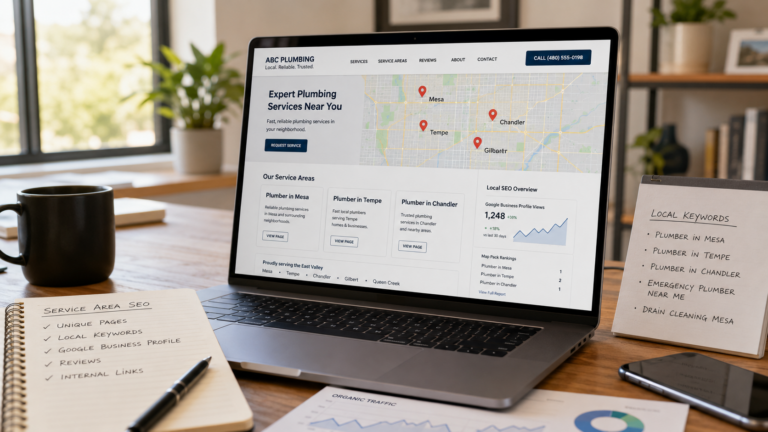
Your website is the next major factor. Google needs a place to confirm who you are, what you do, and where you do it. If your site only says “we serve the greater area,” that is not enough. Clear service pages, well-built location or service-area pages, fast mobile performance, and strong contact information all help search engines understand your relevance.
Then there are citations and directory profiles. These are mentions of your business name, address, phone number, and other core details across trusted platforms. They are not glamorous, but consistency matters. If one directory shows an old number, another uses a different business name, and a third has the wrong hours, you create confusion for both users and search engines.
Finally, local authority still matters. Links from relevant local organizations, chambers, associations, sponsorships, industry sites, and regional publications can strengthen your market position. The key is earning signals that make sense for your business, not chasing random backlinks that look good in a spreadsheet but do nothing for lead flow.
How local SEO for service businesses turns into leads
Rankings are only part of the job. What matters is whether visibility turns into calls, form submissions, direction requests, and booked work.
That is why service businesses need to think beyond traffic. A page ranking for “roof repair” is not very useful if it does not clearly show your service area, answer the customer’s main questions, and make it easy to call. A Google Business Profile with solid visibility still underperforms if the photos are weak, the categories are off, or the reviews do not speak to the services people are actually searching for.
The best local SEO strategy connects ranking signals with conversion signals. That means showing up in the right searches, then giving people enough confidence to choose you.
Common mistakes that waste time and money
One common mistake is treating every town the same. If you create ten nearly identical city pages and swap out the place name, Google usually sees right through it. More importantly, customers do too. A useful local page should reflect real service relevance, real customer intent, and content that helps someone decide whether to contact you.
Another mistake is relying too heavily on your Google Business Profile while neglecting the website. Profiles are powerful, but they are not a substitute for a strong site. You do not control Google’s platform the way you control your own web presence. If your profile gets filtered, suspended, or outranked, your website becomes even more important.
There is also the reporting trap. Some providers focus on impressions or ranking screenshots while avoiding harder questions like whether calls increased, whether leads improved, or whether the traffic came from the right service areas. Small business owners do not need vanity metrics. They need visibility tied to real business outcomes.
What a practical local strategy looks like
A practical strategy starts with cleanup. Your business information should be accurate and consistent across your site, Google Business Profile, and directories. Then your website should be organized around your actual services and target areas, not broad generic language.
From there, content should support buying intent. That might mean stronger core service pages, thoughtful city pages for areas you truly serve, and FAQs that address the real concerns customers have before calling. Reviews should be requested regularly through a simple process your team can actually maintain. Photos and profile updates should happen often enough to show that the business is active.
At the same time, tracking needs to be in place. If you do not know which pages drive calls, which locations generate leads, or whether Maps visibility is improving, it becomes very hard to make smart decisions. Good local SEO is not just execution. It is measurement and adjustment.
For multi-location businesses, the strategy needs more structure. Each location should have its own profile, its own landing page, and clear location-specific signals. For service-area businesses, the approach needs to balance broad coverage with credible local relevance. It depends on how your business is set up, how far you travel, and how competitive your market is.
What to expect from local SEO over time
Local SEO can produce early wins, especially if your profile is incomplete or your listings are a mess. But the bigger gains usually come from steady monthly work. That is because local search is competitive and cumulative. Reviews build over time. Website authority builds over time. Content earns trust over time.
This is where transparency matters. If someone promises instant domination across every nearby city, be careful. Real local SEO is consistent, compliant, and grounded in your actual business footprint. It should feel like building an asset, not gambling on a shortcut.
For busy owners, that is usually the real value of working with an experienced partner. The work gets done, the strategy stays aligned with Google’s rules, and you get reporting that makes sense without having to become an SEO expert yourself. That is the approach Nautical Agency is built around – practical local growth, clear deliverables, and no unnecessary lock-in.
If your business depends on nearby customers, local visibility is not a side project. It is part of your sales system. The businesses that treat it that way tend to get found more often, get trusted faster, and get more chances to win the job.