Most small business websites do not have a traffic problem. They have a conversion problem. A company can show up in local search, get the click, and still lose the lead because the site feels vague, slow, outdated, or hard to trust. That is why website optimization for local leads matters. It is not about making a site prettier. It is about helping nearby customers choose you fast.
If you depend on calls, quote requests, appointments, or walk-ins, your website has one job: turn local intent into action. That means your pages need to match what people searched for, prove you serve their area, and make the next step obvious. When those pieces are missing, even strong rankings can underperform.
What website optimization for local leads actually means
A lot of business owners hear “website optimization” and think of technical tweaks that only developers care about. Some of that matters, but local lead generation is more practical than that. Your website needs to answer four questions almost immediately: what do you do, where do you do it, why should someone trust you, and how do they contact you right now?
That sounds simple, but many local sites fail one or more of those tests. A plumber may describe services well but never mention the actual towns served. A law firm may have strong credentials but bury the contact form halfway down the page. A med spa may look polished but load slowly on mobile, where most local searches happen. These are not small issues. They directly affect whether a visitor becomes a lead.
Local website optimization sits at the intersection of SEO and conversion. You want Google to understand your services and service areas, but you also want real people to move from “maybe” to “let’s call them.” Those goals support each other when the site is built with local intent in mind.
The pages that drive local leads
Not every page carries the same weight. If your site is trying to generate leads from nearby customers, a few page types usually matter more than the rest.
Your homepage should clearly state the core service, the main location or service region, and the primary call to action. This is not the place for clever headlines that hide what you do. If someone lands there from Google, they should know within seconds whether they are in the right place.
Service pages are where many local businesses win or lose. Each major service needs its own page with specific language around the problem, the solution, and who it is for. If you lump everything into one general page, you make it harder for search engines to match your site to specific searches and harder for buyers to feel understood.
Location pages matter when you serve multiple cities or neighborhoods. Done well, they help you show relevance in more than one area. Done poorly, they become thin, repetitive pages that add little value. The difference usually comes down to specificity. A strong location page reflects the actual market, service demand, common customer concerns, and clear proof that your business works there.
Contact pages also carry more weight than people think. For local businesses, this page should be friction-free. Phone number, form, business hours, service area details, and clear expectations about response time all help. If a visitor has to hunt for basic contact details, some will leave instead of reaching out.
Local trust signals are not optional
People hiring a local business are making a judgment call fast. They may compare three companies in ten minutes. In that window, trust signals matter as much as rankings.
Reviews are a big part of that, but they should not live only on your Google Business Profile. Relevant testimonials on key service and location pages can reassure people at the exact moment they are deciding. Before-and-after photos, project examples, certifications, licensing details, years in business, and service guarantees can all help too, depending on the industry.
There is a trade-off here. Some sites overdo trust badges and clutter the page. Others make visitors work too hard to find proof. The right balance depends on your industry and buyer urgency. An emergency HVAC customer may need a quick credibility check and a visible phone number. A higher-ticket remodeling prospect may want more examples and a longer decision path.
The goal is not to overwhelm visitors with claims. It is to remove doubt.
Mobile speed and clarity win local searches
Most local searches happen on phones, often when the customer is ready to act. If your site is slow, hard to tap, or awkward to read on mobile, your lead flow suffers even if your rankings look fine.
Mobile optimization is not just shrinking the desktop layout. Important information should appear early. Buttons should be easy to tap. Forms should ask for only what you truly need. Large image files, messy code, and bloated plugins often create delays that cost leads.
This is one area where business owners sometimes chase the wrong goal. A flashy website is not the same as a high-performing website. Animation, oversized video, and complex design features may look impressive in a review meeting, but they can hurt speed and distract from the action you want visitors to take.
For local lead generation, clarity usually beats complexity.
On-page SEO that helps both rankings and conversions
Good on-page SEO for local businesses is straightforward when done right. Your page titles, headings, body copy, and internal structure should make it obvious what service you offer and where you offer it. That gives search engines context and gives visitors confidence.
This does not mean stuffing city names into every sentence. Forced keyword use reads badly and can weaken trust. Instead, each page should naturally reflect one core topic. A roofing service page should be about roofing. A page for roof repair in a specific city should speak directly to that service and market.
Schema, crawlability, indexation, and clean site structure matter too, but those technical pieces should support the business goal, not become the whole strategy. A technically perfect site with weak messaging still loses leads. A persuasive site with major technical problems may never get enough visibility to matter. Local SEO works best when both sides are handled together.
Why service area content is often the missing piece
Many small businesses serve multiple towns but only mention one city on the site. That creates a gap between the real business footprint and the digital one.
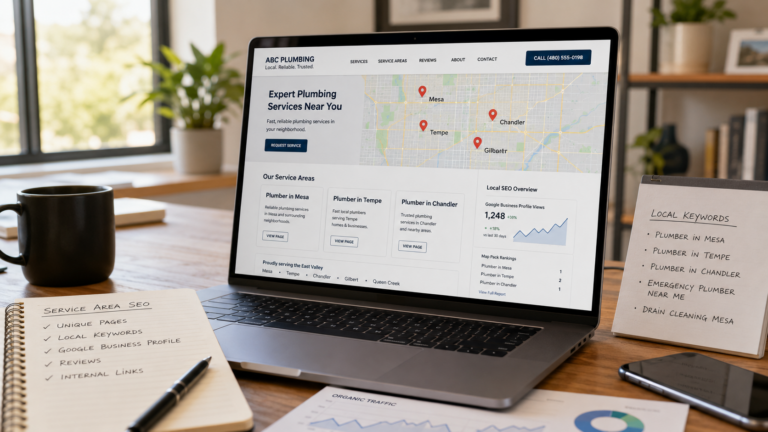
If you work across several communities, your website should reflect that with purpose-built service area pages or well-structured geographic content. This is especially important for home service companies, professional services, and multi-location businesses trying to build consistent visibility.
The catch is that geographic pages need substance. Swapping one city name for another is not a strategy. Strong local pages speak to local relevance. They may reference the types of properties you serve, common service needs in that area, scheduling expectations, or recent project work nearby. The content should feel like it belongs to that market.
This is one reason many businesses benefit from working with specialists who can optimize the site without forcing a full rebuild. A focused local SEO team can often improve page targeting, lead flow, and reporting by collaborating with your current developer and tightening the parts that affect performance most.
How to tell if your website is costing you leads
You do not need perfect analytics to spot a problem. If your site gets traffic but few calls or forms, that is a warning sign. If people visit location pages but do not contact you, the message may not match their intent. If mobile users bounce quickly, the experience may be too slow or confusing.
Other signs are more subtle. Maybe your competitors with weaker brands seem to show up more often in Maps and organic results. Maybe your website talks broadly about the business but not specifically about the services and towns that drive revenue. Maybe your reporting shows clicks, but not whether those clicks became real opportunities.
This is where transparency matters. You should be able to connect website changes to meaningful outcomes like calls, form submissions, direction requests, and booked jobs. If your SEO reports are full of impressions but thin on lead data, you are not getting the full picture.
The best local websites make the next step easy
The strongest local websites do not try to impress everyone. They help the right customer act. The messaging is clear. The service areas are visible. The proof is credible. The call to action is simple. And the site is built around how local people actually search and decide.
That usually means fewer distractions, better page targeting, and more intentional conversion points. It may also mean reworking service pages, tightening your local relevance, or fixing the mobile experience before spending more on traffic. More visitors do not solve a weak website. A better website makes your existing visibility worth more.
If your site already gets some local attention, that is good news. You may be closer than you think. A handful of focused improvements can turn an underperforming website into a steady source of qualified local leads. The key is to stop treating the website like an online brochure and start treating it like the sales tool it already is.