If you run more than one location, you have probably seen this happen: one branch shows up in Google Maps all the time, while another barely appears for the same service. Same brand, same website, same general offer – very different results. That gap is exactly why local SEO for multiple locations needs a different approach than single-location SEO.
The challenge is not just getting found. It is getting each location found for the right searches in the right market without creating duplicate pages, confusing Google, or sending customers to the wrong phone number. For small business owners, that usually means lost calls, missed direction requests, and a lot of guesswork about what is actually working.
Why local SEO for multiple locations gets complicated fast
With one location, your local presence is relatively simple. You have one Google Business Profile, one main address, one set of citations, and usually one core service area. Once you add a second, third, or tenth location, consistency becomes harder and local relevance becomes more specific.
Google does not rank a brand as a whole in local search the way many owners assume. It evaluates individual locations based on proximity, relevance, and prominence. That means every branch needs its own accurate signals. If your Dallas office has a weak profile, thin location page, and mixed directory information, it can struggle even if your Houston office is doing great.
This is where many businesses go wrong. They build one generic locations page, paste the same paragraph onto every city page, and expect all branches to rank. Google is better than that, and customers are too.
What actually drives rankings across locations
Strong multi-location SEO usually comes down to three systems working together: your Google Business Profiles, your website’s location pages, and your business information across the web.
Your Google Business Profile is often the first place local visibility is won or lost. Each eligible location needs its own profile with the correct business name, address, phone number, primary category, secondary categories, hours, services, and images. Profiles also need ongoing management. Reviews, Q&A, service updates, and occasional photo activity all help keep listings active and useful.
Your website then needs to reinforce those location signals. Every location should have a dedicated page that clearly matches the business details in its profile. That page should not be a carbon copy of every other branch page. It needs unique content tied to that market, the services available there, and the customer intent in that area.
Then there is your citation footprint – directories, map apps, industry listings, and business databases. These listings do not need to be glamorous, but they do need to be accurate. Even small inconsistencies in phone numbers, suite numbers, or naming conventions can muddy the signals Google uses to trust your location data.
Build location pages that deserve to rank
For most multi-location businesses, location pages are the weak point. They exist, but they do not help much. A strong location page should do two jobs at once: prove local relevance to Google and make it easy for a customer to take action.
That means the page needs the basics done right. Include the specific location name, address, phone number, service details, hours if applicable, and a clear call to action. But the basics alone are not enough. The content should also reflect that branch’s market. Mention neighborhoods served, common service requests in that area, local proof points, and anything operationally different about that location.
If all ten pages say the same thing except for the city name, you are giving Google very little reason to rank them separately. Unique content does not mean fluff. It means useful information a local customer would actually want.
What good location content looks like
A useful page often includes a short overview of the services offered at that branch, service-area details if the business travels to customers, location-specific testimonials, and practical information about parking, access, scheduling, or response times. For a home services company, you might talk about the towns covered from that office and the types of jobs most often handled there. For a retail business, you might focus on in-store offerings, nearby landmarks, and what customers can expect when they visit.
The point is simple: each page should feel like it belongs to a real place, not a spreadsheet.
Google Business Profile management matters more than most owners think
A lot of businesses set up their profiles once and leave them alone. That is usually not enough, especially when competitors are actively improving theirs.
Each location’s profile should be fully completed and aligned with the corresponding page on your website. Categories matter. Services matter. Photos matter. Reviews matter a lot. If one branch has fifty recent reviews and another has three from two years ago, that second location is at a disadvantage even if it is operationally strong.
Review strategy is especially important for local SEO for multiple locations. You do not want all reviews flowing to one location while others stay quiet. The better approach is to ask customers to review the exact branch they used. That creates stronger local proof and supports rankings where the revenue actually happens.
There is also a practical customer benefit. Accurate hours, direct phone numbers, and current photos reduce friction and increase trust before someone ever clicks through to your site.
Consistency is non-negotiable, but sameness is a mistake
This is one of the biggest trade-offs in multi-location SEO. You need consistency in your core business data, branding, and structure. But you do not want every asset to look identical.
Consistent means the name, address, phone number, category choices, and website destination make sense across profiles and directories. It also means each location page follows a clear format so users can find what they need quickly.
Sameness is different. Sameness is copying the same text onto every location page, using the same generic title tags, and publishing no branch-specific information. That creates weak local relevance and often weak conversion rates too.
The right balance is standardized structure with localized detail.
Common mistakes that hold back multi-location rankings
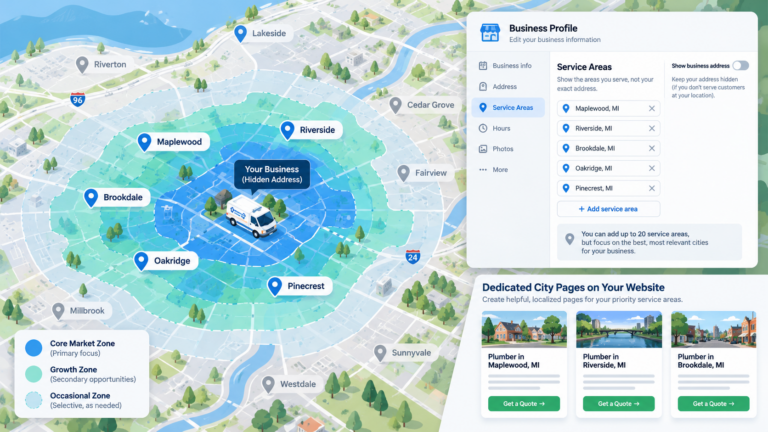
Some problems show up over and over. Businesses point multiple Google profiles to the homepage instead of the matching location page. They use tracking numbers in places that create citation inconsistency. They merge service-area content and physical location content in a way that confuses both users and search engines. Or they create pages for cities where they do not have a legitimate location and expect local map visibility there.
Another common issue is uneven execution. One branch gets attention because the manager asks for reviews and updates photos. The rest are ignored. Multi-location SEO only works well when there is a repeatable system behind it.
That system should cover profile optimization, website updates, citation management, review generation, reporting, and content support. Without that, growth tends to be random.
How to measure whether it is working
The goal is not just more impressions. The goal is better local visibility that turns into leads.
For each location, you should be able to track rankings in its target market, Google Business Profile activity, organic traffic to the location page, calls, form submissions, and direction requests where relevant. If your reporting only shows sitewide traffic, it is hiding the real picture.
Location-level reporting helps answer the questions owners actually care about. Which branch is gaining visibility? Which market is slipping? Which pages are producing leads? Which profiles need attention? That is where real decision-making happens.
At Nautical Agency, this is the part many small businesses appreciate most. When reporting is clear and tied to actual outcomes, SEO stops feeling like a black box and starts feeling like a growth channel you can manage.
The businesses that win treat each location like its own market
That does not mean each branch needs a completely separate marketing department. It means each location needs enough dedicated attention to compete where it operates. Search behavior varies by city. Competition varies by zip code. Even review patterns and service demand can differ from one branch to the next.
The businesses that gain ground in local search are usually the ones that accept that reality early. They do not rely on one generic website page and a handful of listings. They build a framework that gives every location a real chance to rank, convert, and grow.
If you are trying to improve visibility across multiple branches, keep the goal simple: make it easy for Google to trust each location and easy for customers to choose it. When those two things line up, rankings tend to follow – and so do the calls.